UN Investigators Conclude Iran Violated Arms Embargo

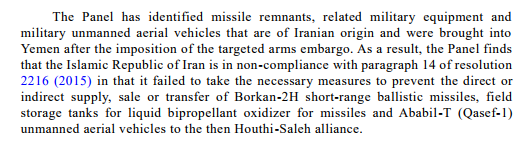
Feb. 27, 2018 – Iran is in violation of a Security Council imposed arms embargo, UN investigators have concluded.

The investigators made their findings known in an annual report to the 15-nation body. 
Resolution 2216 prohibits the transfer of arms to the late Ali Abdullah Saleh as well as to Houthi rebels.

The full report from the UN panel of experts on Yemen is below.

Final Report UN Panel of Experts Yemen

UNICEF Deputy Resigns After Inappropriate Behavior Allegations Emerge

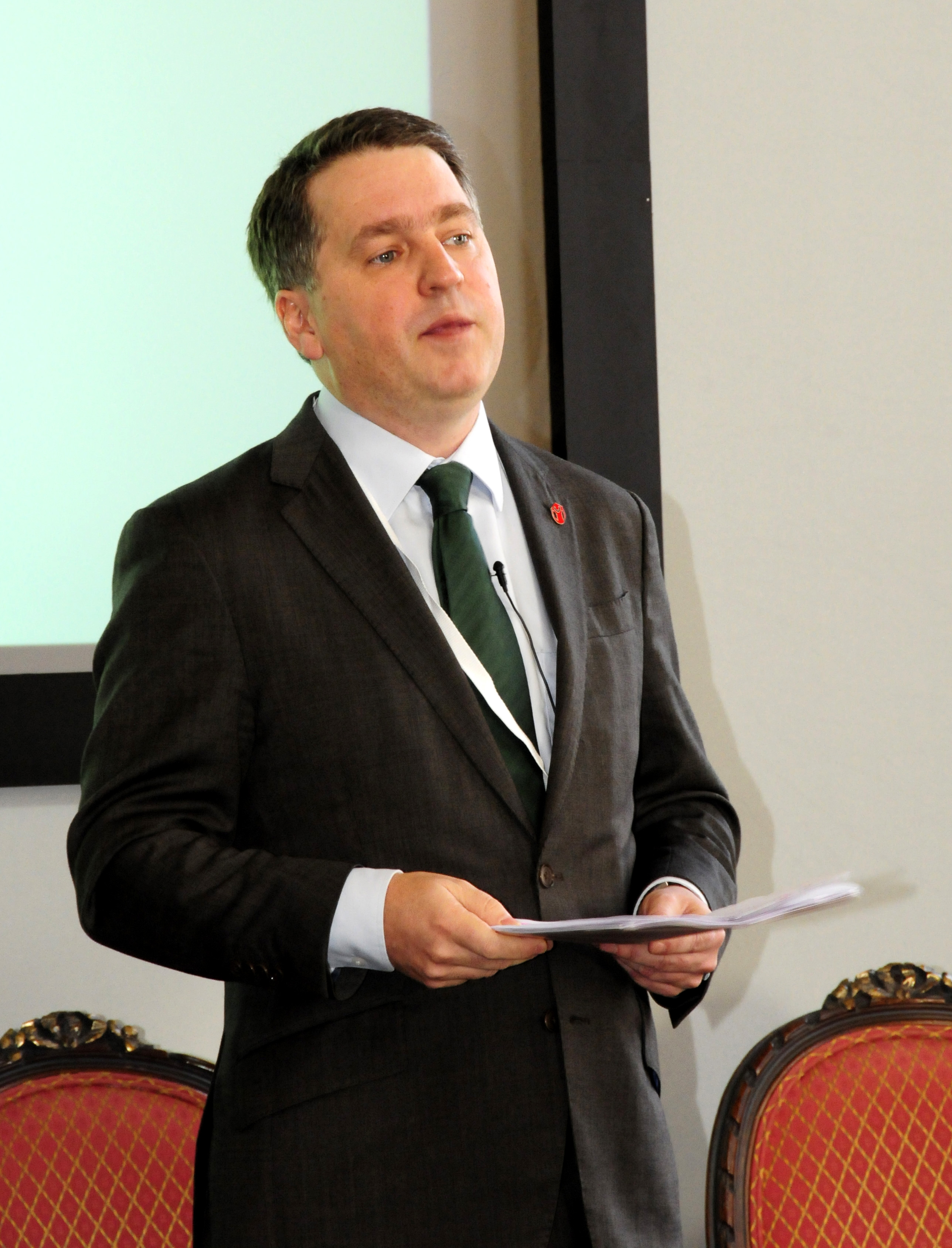
(image: wikimedia commons)

Feb. 22, 2018 – The deputy director of UNICEF has announced his resignation saying he does not want to do damage to the organization or to the charity Save the Children, his previous employer.

Reports emerged this week that accused Forsyth of inappropriate behavior, emails and text messages to female employees of Save the Children, the British charity where he was chief executive.

His resignation was welcomed by the British-based Women’s Equality Party.

Forsyth’s full resignation statement is below.

With heavy heart, I am today tendering my resignation to UNICEF as Deputy Executive Director. It has been a huge honour to work for UNICEF over the last two years, fighting for the rights of children around the world. It is an extraordinary force for good and I know it will have even more impact in the coming years under the leadership of Executive Director Fore. I wish my friends and colleagues at UNICEF and the UN well.

I want to make clear I am not resigning from UNICEF because of the mistakes I made at Save the Children. They were dealt with through a proper process many years ago. I apologised unreservedly at the time and face to face. I apologise again.

There is no doubt in my mind that some of the coverage around me is not just to (rightly) hold me to account, but also to attempt to do serious damage to our cause and the case for aid. I am resigning because of the danger of damaging both UNICEF and Save the Children and our wider cause. Two organisations I truly love and cherish. I can’t let this happen.

I have given 30 years of my life to fight against injustice and poverty and for children. From South Africa to Rwanda to Syria I have tried my best to help tilt the course of events for children and the most disadvantaged. We have sometimes failed, but I feel privileged to have had the chance to help millions of children. I have worked with some extraordinarily talented and committed people at both UNICEF and Save the Children.

Finally, I want to thank my wife Lisa for her love. I am looking forward to spending more time with her and my son.”

UN Spent $319 Million on Staff Travel Last Year


Feb. 8, 2018 – UN Secretariat staff took almost 100,000 trips last year at a cost to the global taxpayer of $319 million, according to a new report by Antonio Gutteres.

The UN chief was tasked by the General Assembly to issue the report and to devise recommendations for cutting down on travel costs.

Of the 98,000 flights taken by some of the 41,000 people working for the UN Secretariat, 12,000 were in business class and just 51 traveled by first class, and that number looks set to decrease.

In his conclusions, Guterres says assistant and under-secretaries general representing him in an official capacity should no longer travel first class but stick to business class for all their travels.

Business class is offered to UN staffers when their flight time is 9 hours or more. This is not insignificant as the flight from New York to Geneva, a popular route for world body employees, is just over nine hours. [Correction: A reader pointed out that the travel time from NYC to Geneva is 7.5 hours and that unless there is a special circumstance UN staff travel on economy for these trips.]

The deputy secretary-general and the president of the General Assembly still retain their first class travel rights.

The average cost of travel for UN staffers works out at about $3,000 with about half that spent on the price of the flight.

The full report is here.

– Denis Fitzgerald
On Twitter @denisfitz

Global Hunger on Rise, Mostly Caused by Increasing Conflict


January 31, 2018 – Hunger is on the rise again after seeing a reversal in the past few years. The majority of those suffering from hunger are living in conflict affected countries.

A new report from the World Food Program and the UN Food and Agricultural Organization states that the number of people globally who are food insecure rose from 777 million to 815 million last year.

Of those, almost 500 million are living countries affected by conflict including Afghanistan, DR Congo, Somalia, South Sudan and Yemen.

In Afghanistan, more people are being driven from their homes as a resurgent Taliban is now active in 80 percent of the country.

Conflict in Eastern DR Congo is the prime driver of hunger in the country with some 72 million people food insecure.

In Lebanon, not traditionally on the list of countries suffering from hunger, up to a third of Syrian refugees living in the country regularly go hungry.

The almost three year old war in Yemen has proven catastrophic for the population, where the humanitarian situation was already precarious before the Houthi takeover of Saana and subsequent air campaign by a Saudi-led coalition. Some 60 percent of the people in the Arab world’s poorest country are in need of food assistance.

Forty-five percent of South Sudanese need food aid. The world’s newest country has been beset by conflict since it declared independence in 2011. A complete and utter disregard for the people by political leaders is the prime cause for the lack of a political solution.

Four years of conflict has also brought hunger to Ukraine, where some 26 percent of the population, mostly in the country’s east, are in need of food assistance.

The full report is here.

– Denis Fitzgerald
On Twitter @denisfitz

Only 14 Countries Have Paid 2018 UN Dues

Jan 24, 2018 – South Sudan and Benin have paid their 2018 United Nations dues but the world body’s biggest contributors, the United States, Japan and Germany have still to pony up, according to latest figures from the Committee on Contributions.

Only 14 countries have paid as of January 23, and besides the United States, none of the other permanent members of the UN Security Council have paid up yet.

Member states are being given until Feb. 9 to pay in full but if past years are any indication only some 15 percent of the UN’s 193 member states will have stumped up by then.

The 14 countries that have paid their dues so far are as follows:

Member State
Net assessment
(in US$)

Date of Payment

1 Armenia
145,843
10-Jan-18
2 Benin
72,921
10-Jan-18
3 Hungary
3,913,439
10-Jan-18
4 Liberia
24,307
10-Jan-18
5 Poland
20,442,246
10-Jan-18
6 South Sudan
72,921
10-Jan-18
7 Ukraine
2,503,629
10-Jan-18
8 Australia
56,805,623
17-Jan-18
9 New Zealand
6,514,294
17-Jan-18
10 Latvia
1,215,354
18-Jan-18
11 Switzerland
27,710,060
18-Jan-18
12 Canada
71,000,953
19-Jan-18
13 Luxembourg
1,555,653
19-Jan-18
14 Norway
20,636,703
23-Jan-18


Iran to End Death Penalty For Many Drug Offenses


January 10, 2018 – The Iranian judiciary on Tuesday amended the country’s drug trafficking law, which if implemented, could save the lives of about 4,000 of the some 5,000 inmates on death row in the Islamic Republic.

The order to suspend death sentences for drug-related crimes pending sentence reviews—issued by Judiciary Chief Sadegh Larijani —requires judges to rescind death sentences that do not meet the new conditions set by parliament for the death penalty, according to the Center for Human Rights in Iran.

The amended law allows for sentence of the death penalty in cases of armed drug-trafficking, using children to traffic drugs, previous death sentences, life sentences and sentences of 15 years or more, as well as playing a leading role in a drugs organization and possession of certain quantities of drugs, including 50 kilos of opium, two kilos of heroin and three kilos of amphetamines, according CHRI.

UN Officials have in recent years urged those countries that continue to execute their own citizens to limit it to people convicted of murder or intentional killing following a fair and transparent process.

The UN General Assembly has since 2007 annually passed a resolution calling for a moratorium on the use of the death penalty. The resolution, spearheaded by EU countries, particularly France and Italy, is supported by some 100 countries while about 40 countries consistently vote against it.

The text of the General Assembly resolution on establishing a moratorium also calls on states that retain the use of executions to limit the number of offenses for which the death penalty can be applied.

In addition to Iran, at least seven states, including Saudi Arabia as well as Vietnam, Indonesia, Malaysia, Singapore, and China impose the death penalty for drug trafficking.

But it’s not just drug crimes that are punishable by death in some countries. Apostasy is considered a capital crime in both Saudi Arabia and Iran. In Yemen, there are some 360 crimes punishable by death including adultery and prostitution. In Morocco, there are more than 325 while in Egypt there are more than 40, and death sentences have increased there since the 2011 protests that led to the fall of former dictator Hosni Mubarak.

Confidence is high that over time the death penalty will be abolished universally.

When the UN was founded only eight countries had taken the death penalty out of their laws while the figure is now 99, and only five states now execute more than 25 people per year – China, Iran, Saudi Arabia, Iraq and the United States.

UN officials have yet to comment on the amended law but The Center for Human Rights in Iran warned that the “the ultimate decision lies with Iranian judges, which have historically yielded to pressure by hardline security agencies in issuing sentences regardless of the law.”

– Denis Fitzgerald
On Twitter @denisfitz
UN Chief: Iranian Weapons Proliferation Under Investigation

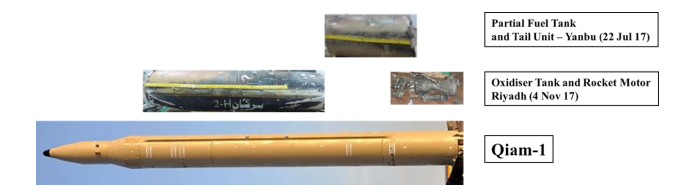
Numbers mark features that supposedly identify Iranian Qiam-class ballistic missile remnants on display at Joint Base Anacostia-Bolling in Washington, D.C., Dec. 12, 2017 .

Dec. 15, 2017 – Antonio Guterres has reported to the Security Council that the UN is examining evidence that Iran has transferred ballistic missiles to Houthi rebels in Yemen in violation of Security Council resolutions.

Saudi authorities claim a missile fired at Riyadh airport last month was of Iranian origin, a claim backed by the United States, whose ambassador, Nikki Haley, presented evidence at a military base in Washington DC on Dec. 12 of what she says is confirmation of Iranian weapons proliferation.

In his report, Guterres says that markings found on remnants of missiles fired into Saudi Arabia by Houthis bore similarities to a logo used by a sanctioned Iranian industrial company.

His full report is here.

US Still Biggest Aid Donor to United Nations, But That May Change

November 16,2017 – The United States is still the biggest donor to United Nations aid programs but there is uncertainty if that will be the case in 2018 as the Trump administration seeks to cut spending and to specifically reduce spending on UN programs.

If the $1.5 trillion tax bill put forward by Republicans passes then cuts to certain programs will be made to reduce the overall impact on the federal deficit, and cuts to the UN will be an easy target. In addition, the Trump administration has also said it plans to shift some of its aid money away from UN programs and instead give to groups working for persecuted minorities in the Middle East. Little detail has been provided so far on this.

But as it stands, the US remains the top donor so far in 2017 to UN relief programs, contributing $4.2 billion or 33 percent of all funds received this year, according to information from the United Nations Office for the Coordination of Humanitarian Affairs.

The top country recipient for US funds this year is South Sudan, $483 million, followed by Syria, $459 million, and Yemen, $427 million.

The European Union is the next top donor to UN aid programs, contributing a total of $1.7 billion.

Other top donors include:

Germany $1.5 billion,
United Kingdom $998 million
Japan $402 million
Sweden $269 million

– Denis Fitzgerald
On Twitter @denisfitz
Latin America, Middle East Deadliest Place for Teens


November 9, 2017 – Adolescents in Middle Eastern and Latin American countries stand the greatest risk of a violent death, according to a new report from the UN children’s agency.

More than half of the 51,000 teenage homicides globally occur in Brazil, Colombia, El Salvador, Honduras and Venezuela while adolescents are killed from conflict and civil war in the Middle East at a rate higher than all other regions combined, with the greatest burden on Iraq and Syria.

Overall, there were 89,000 adolescents violently killed last year, or one death every seven minutes.

For boys, the risk of dying violently is highest in Colombia, El Salvador, Iraq, Syria and Venezuela while for girls the risk is highest in Syria, Iraq, Honduras as well as Afghanistan and South Sudan.

Sex and race distinctions put some groups of teens at a higher risk. For example, the rate of homicides among teenage boys is four times greater than that of girls and teenage boys are far more likely to be killed by a stranger.

Teenage girls on the other hand have a far greater risk of being killed by a family member. Globally, almost 50 percent of female homicides are perpetrated by family or intimate partners compared with six percent for males.

In the United States, African-American teenage boys are 19 times more likely to be a victim of a homicide than all other races. If the rate of homicides for Black teenagers in the U.S. was applied nationwide, the United States would be among the ten deadliest places for teenagers.

Teenage girls stand a far higher risk of sexual violence than boys but the authors note that limited data on sexual violence and boys constrains their understanding of the full extent of the problem. Worldwide, some 9 million girls aged between 15-19 were the victims of rape last year.

The full report is here.

– Denis Fitzgerald
On Twitter @denisfitz
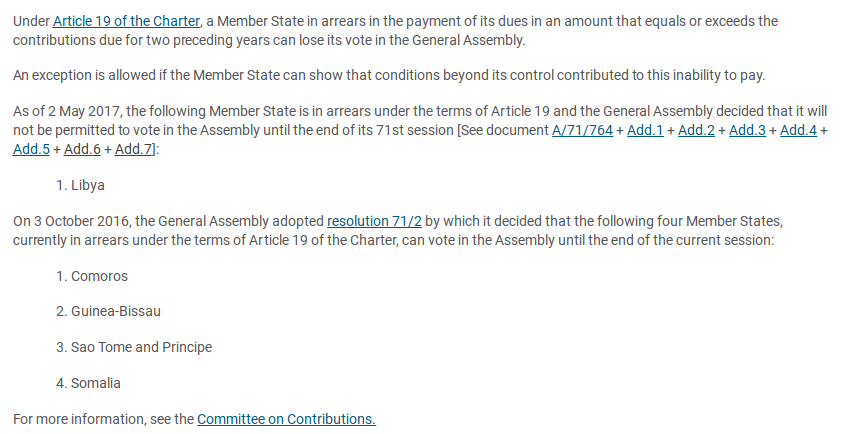
Libya Still Without Vote in UN General Assembly

August 1, 2017 – Libya remains in arrears to the United Nations and will not be allowed vote for the remainder of the General Assembly’s 71st session, which ends next month.

Sudan and Venezuela also had their voting rights suspended this year for non-payment of dues but have since made the necessary payment to put them back in good standing.

Article 19 of the UN Charter states that countries will lose their UNGA vote if their “arrears equals or exceeds the amount of the contributions due from it for the preceding two full years.”

In all, a total of 116 countries have paid their 2017 dues, according to the Committee on Contributions, but noticeably, permanent members France and the United States have yet to pay.

The US typically makes a payment in October when its financial year begins.

– Denis Fitzgerald
On Twitter @denisfitz